

I’ve stared at my running shoes, feeling like they weighed a hundred pounds each. The alarm goes off, and every cell in my body screams for five more minutes. I know that feeling—the deep, hollow ache of having zero gas in the tank.
You want to prioritize your fitness, but your energy is just… gone. It’s a real, frustrating wall. For years, I thought I had to wait for motivation to strike like lightning. I was wrong.
True, lasting drive isn’t about a magical bolt of energy. It’s about building a simple, forgiving system that works on your lowest days. This is the from-the-trenches advice that changed everything for me.
Table of Contents
Key Takeaways
- Motivation is a system you build, not a feeling you wait for.
- Tiny, manageable actions create powerful momentum.
- Your physical environment has a huge impact on your habits.
- Celebrate every small win; progress is rarely a straight line.
- On tough days, showing up consistently is more important than intensity.
- Listen to your body’s signals, but don’t let fatigue make all the decisions.
- Connecting with others can provide a surprising energy boost.
When Your Get-Up-and-Go Has Gotten Up and Gone: You’re Not Alone
Calling yourself ‘lazy’ for skipping the gym is unfair. If you’re reading this, you’ve likely felt that deep-seated resistance. Even thinking about a workout feels exhausting. This is a universal experience, especially when you’re dedicated to staying motivated to exercise.
The first step out of this rut isn’t more discipline. It’s more understanding.
Let’s put the blame game aside. We’re going to look at what’s really happening beneath the surface of that “I just can’t” feeling. It’s rarely about a character flaw. More often, it’s a signal from your body and mind that needs decoding.
Why That “Lazy” Feeling Is Often Deeper Than Laziness
We live in a culture that glorifies hustle and often equates rest with weakness. When we don’t meet that impossible standard, the easiest label to reach for is “lazy.” But what if that label is stopping you from finding real solutions?
Laziness implies a simple choice—a decision not to do something. What you’re experiencing is likely more complex. It’s a physical or emotional barrier that makes the choice incredibly difficult. Self-judgment adds a heavy layer of guilt on top of your existing fatigue, making the mountain to climb even steeper.
True laziness is passive and content. If you’re frustrated by your lack of action and searching for ways to fix it, you’re not lazy. You’re someone encountering a very real obstacle on your fitness journey.
Untangling the Web of Fatigue: It’s More Than Just Sleep
We blame a bad night’s sleep and call it a day. While sleep is crucial, fatigue is a web with many threads. Sometimes you can sleep eight hours and still wake up feeling drained, with zero drive for staying motivated to exercise.
This kind of exhaustion has two primary, interwoven sources: one in your mind and one in your body. Untangling them is key to regaining your energy.
Your brain is a high-performance organ, and it burns a ton of energy. The mental load—the constant planning, worrying, list-making, and emotional labor of daily life—is like having a dozen browser tabs open in your mind. This cognitive drain directly impacts your physical capacity.
By the time you consider a workout, your mental battery is already in the red. This isn’t an excuse; it’s a physiological reality. Your body’s resources are finite. When your brain uses them all on managing stress, work deadlines, or family logistics, there’s little fuel left for physical exertion.
As one wise person put it:
“You cannot pour from an empty cup.”
This applies to your physical energy as much as your emotional energy. Recognizing this mental tax is the first step in managing it.
How Hormonal Cycles Can Impact Energy and Motivation
For women, the physiological component of fatigue is powerfully influenced by hormonal cycles. Energy, strength, and motivation naturally ebb and flow throughout the month. Ignoring this rhythm is like trying to swim against a current.
In the week before your period, progesterone rises and then falls, which can cause a significant dip in energy and an increase in the need for rest. During your period itself, low estrogen and progesterone can make you feel fatigued. Conversely, in the week after your period, rising estrogen often brings a natural boost in energy, stamina, and drive.
This isn’t about making excuses. It’s about working with your body, not against it. Planning intense workouts for your high-energy phase and gentle movement or rest during your low-energy phase is a strategic way to support long-term consistency in staying motivated to exercise.
When you understand these deep roots of fatigue—both the mental and the hormonal—you can replace frustration with strategy. You stop fighting your own body and start listening to it. This compassionate understanding is the solid foundation upon which real, sustainable motivation is built.
Forget Willpower: Building a Motivation Engine That Runs Without It
What if the biggest obstacle to your workout clothes is the idea of ‘feeling motivated’? I once spent too much time waiting for a spark of drive. The truth is, willpower is weak. What you need is a self-charging engine.
This engine doesn’t care how you feel. It runs on a simple, proven rule. You build it by understanding one core shift. Let’s move from hoping for motivation to engineering it.

Motivation Follows Action, Not the Other Way Around
We have the sequence all wrong. We think: Feel motivated → then act. But the real, powerful sequence is: Act first → then motivation shows up. This is a psychological principle called behavioral activation.
Your brain rewards action with dopamine. This creates a sense of accomplishment and forward momentum. That feeling? That’s exercise motivation being generated, not found.
Don’t believe me? Try the five-minute rule. Promise yourself just five minutes of movement. By minute five, you often want to continue. The action itself built the drive to keep going.
| Old Model: Willpower-Dependent | New Model: Action-First Engine |
|---|---|
| Waits for the “right” feeling to start. | Starts with a tiny, manageable action. |
| Treats motivation as a finite fuel tank. | Treats action as the ignition switch. |
| Leads to guilt and “failure” on low-energy days. | Creates wins and momentum on any day. |
| Focuses on the daunting end goal. | Focuses on the simple next step. |
My Personal Shift from Waiting for Inspiration to Creating It
My own breakthrough came after a string of failures. I’d set a 6 a.m. alarm for a run, hit snooze, and spiral into guilt. I was a prisoner to my mood. I believed I lacked discipline.
The shift wasn’t heroic. It was mechanical. I stopped asking, “Do I want to run?” I started executing a pre-set action: Put on my running shoes and step outside. That was the only non-negotiable.
Some days, I just walked. Other days, the simple act of being outside in my gear made the run happen. I was no longer a passive waiter for inspiration. I became the active creator of my own exercise motivation.
This small change built a reliable engine. Now, my routine starts with action. The feeling of motivation reliably follows, like a faithful friend showing up after I’ve already begun the party.
Fuel Your Fire: The Non-Negotiable Basics of Sustainable Energy
Sustainable energy isn’t about quick fixes. It’s about listening to your body’s basic needs. Even the best fitness motivation tips won’t help if you’re not taking care of the basics. Let’s start with three essential pillars.
Sleep: Your Most Powerful (and Free) Performance Enhancer
Sleep is like your body’s repair shop at night. It’s where muscles rebuild, hormones balance, and your brain processes stress. Without enough sleep, you’ll feel drained and unmotivated.
I used to think I could keep going without sleep. But my workouts suffered, and I felt terrible. Learning to prioritize sleep was a game-changer for me.
Practical Tips for Improving Sleep Hygiene
Good sleep hygiene isn’t about being perfect. It’s about creating a soothing routine that tells your body it’s time to relax.
- Dim the lights: An hour before bed, switch to lamps and avoid bright screens. This helps your natural melatonin production.
- Cool it down: A slightly cool room (around 65-68°F) is ideal for deep sleep.
- Establish a “brain dump” ritual: Keep a notebook by your bed. Write down any lingering thoughts or tomorrow’s to-dos to clear your mental cache.
- Be consistent: Try to wake up within the same hour every day, even on weekends. This regulates your internal clock.
Nutrition That Supports Energy, Not Just Weight Loss
For years, I focused on restricting food, which drained my energy. When I started focusing on fueling, everything changed. Food became my energy source for workouts and daily life.
Complex carbs, lean proteins, and healthy fats are your energy sources. They keep your metabolism going all day.
My Go-To Pre-Workout Snacks for Low-Energy Days
On low-energy days, I don’t force a big meal. Instead, I choose these quick, energizing snacks 30-60 minutes before working out.
- Apple Slices with Almond Butter: Quick energy from simple sugars, plus fat and protein for lasting energy.
- Greek Yogurt with a Drizzle of Honey: Protein-rich and easy to digest, with a touch of sweetness.
- Half a Banana and a Handful of Walnuts: Potassium, carbs, and omega-3s in a convenient package.
- Whole-Grain Toast with Avocado: Sustained energy from carbs and healthy fats, without a crash.
Water: The Overlooked Key to Mental Clarity and Physical Stamina
Even mild dehydration can cause brain fog, fatigue, and a heavy feeling. Your muscles are mostly water. Without enough, they can’t perform well.
I always have a large water bottle on my desk and sip it all day. I also drink a full glass in the morning to rehydrate. It’s a simple fitness motivation tip that makes a big difference.
Mastering these basics gives you a steady energy source. It turns daily tasks into a sustainable flow. Here’s a quick guide to these essential pillars.
| Energy Pillar | Key Action | Primary Benefit | My Simple Rule |
|---|---|---|---|
| Sleep | Protect 7-9 hours for repair | Optimal recovery & hormonal balance | No screens 1 hour before bed |
| Nutrition | Eat to fuel, not just restrict | Sustained physical & mental energy | Include protein + complex carb in every meal |
| Hydration | Sip water consistently all day | Sharp mental clarity & muscle function | Finish one bottle before lunch |
When you get these three elements right, you create a strong foundation for motivation. It’s the most honest work you can do for your fitness journey.
Rewrite Your Inner Dialogue: Mindset Hacks for Lasting Drive
The most powerful workout is the one in your mind before you start. Your thoughts decide if you’ll go to the gym or stay home. By changing your thoughts, you build lasting motivation that doesn’t fade.

This change is key to staying motivated to work out for good. It makes exercise a choice that fits who you are.
Trade “I Don’t Have Time” for “This Is My Time”
Often, saying “I don’t have time” means “this isn’t important.” But, changing it to “This is my time” changes everything.
It means my time for strength, clarity, and self-care. This way, I can be better in all areas of my life. Here’s how to make the switch:
- Catch the thought: Notice when you say “no time.”
- State the new truth: Say, “I am choosing to make this my time.”
- Feel the ownership: You’re giving this time to yourself, not losing it.
This change puts you in control. You’re no longer a victim of your schedule but the creator of your energy.
Visualize the Post-Workout Glow, Not the Pre-Workout Grind
Our brains focus on the hard parts of working out. But, what if you imagined the good parts instead? I do a quick visualization before every workout.
I close my eyes and imagine the post-workout glow. I see the pride, the endorphins, the clarity, and the lightness. I stay with that feeling for 30 seconds.
The dread is in the start. The joy is in the finish. Focus on the end, not the beginning.
This trains your brain to see exercise as a positive reward. Soon, you’ll want that feeling of accomplishment, helping you stay motivated even on tough days.
Anchor Your Why: Connecting Exercise to Your Deeper Values
Goals like losing weight can lose their appeal. To stay motivated, link exercise to what matters most to you. Ask yourself: What does being stronger or healthier allow me to do or be?
Is it about playing with kids without getting tired? Is it about managing stress better? Is it about tackling big projects at work?
Write down your “why.” Keep it visible. When you feel unmotivated, read it again. This deep connection makes skipping a workout feel like a betrayal of yourself.
This deeper “why” is the key to lasting motivation. It’s not just about exercise; it’s about being true to yourself.
How to Stay Motivated to Work Out Women: My Tried-and-True Tactics
I want to share how I turn ‘I can’t’ into ‘I’m doing it.’ It’s all about action, not just theory. My female workout motivation comes from practical steps that remove barriers.
These tactics help me fight low energy and a busy life. They make exercise a natural part of my day.
The Night-Before Prep That Eliminates Morning Excuses
My top strategy is what I do the night before. Decision fatigue kills motivation. By making choices ahead of time, my morning self just has to follow through.
This ten-minute ritual saves me from an hour of debate. It turns a struggle into a smooth process.
Exactly What I Lay Out to Make Mornings Frictionless
I prepare everything I need the night before. Here’s my checklist, ready on my dresser or by the door:

| Category | Specific Items | Why It Matters |
|---|---|---|
| Workout Gear | Leggings, top, sports bra, socks, shoes | No searching; eliminates the “I can’t find my…” excuse. |
| Hydration & Fuel | Full water bottle, pre-made snack (e.g., banana, bar) | Supports energy levels from the very start of the activity. |
| Tech & Accessories | Headphones, charged fitness tracker, pre-loaded playlist | Removes small tech hassles that can derail a session. |
| Post-Workout | Towel, change of clothes, quick breakfast option | Makes the transition after exercise seamless and rewarding. |
Seeing everything ready is a promise to myself. It makes my workout path easy.
The “Just Five Minutes” Promise That Always Works
On tough days, I use a simple trick. I promise myself I only have to move for five minutes. That’s it.
This rule is brilliant because it’s easy for anyone to do five minutes. The secret is that starting creates momentum.
“I almost never stop at five minutes. Once I start, my body remembers it feels good, and my mind gets engaged. The hardest part is always the beginning.”
This method makes starting easier. It turns a “full workout” goal into just starting. Nine times out of ten, those five minutes turn into more.
Treating Your Workout Slot Like a Meeting With Your CEO (You)
I changed everything when I started viewing my workout time as the most important meeting of my day. The CEO? That’s me. I am the boss of my health and well-being.
Would you cancel a critical meeting with your CEO for something trivial? Probably not. Apply the same respect to your self-care appointment.
How Calendar Blocking Creates Unshakeable Commitment
The tool for this is calendar blocking. I schedule my workout like a business meeting in my digital calendar. I set a reminder, and I label it clearly.
Visual commitment is powerful. Seeing that block of time reserved tells my brain it’s non-negotiable. It also helps me plan the rest of my day around it, not the other way around.
If someone asks for my time during that block, I say, “I have a prior commitment.” And I do—a commitment to my future self. This strategy is foundational for learning how to stay motivated to work out women who juggle multiple roles.
It moves exercise from the bottom of the to-do list to a respected part of my schedule.
Honor Your Energy: Smart Workout Scaling for Any Day
What if your workout plan could change with your energy? For years, I thought I had to give 100% every time. But this led to burnout, not progress. Workout motivation for women comes from listening to your body and adjusting your effort wisely.
This section is about being human. Your energy changes like a river. We aim to swim in it, no matter the flow.
Ditching the All-or-Nothing Mentality for Good
The “all-or-nothing” mindset kills motivation. It says if you can’t do the full workout, do nothing. I’ve been there, feeling guilty for not doing my intense workout.
Let’s break this belief. A 15-minute walk counts. Ten minutes of stretching counts. Showing up for five minutes of movement when you promised yourself five counts. These small, adaptable victories build consistency, not perfect standards.
Progress, not perfection, is the goal. When you let go of needing every session to be epic, you remove the pressure that makes you quit.
Your Personal Energy Meter: How to Gauge and Adjust
I created a simple “Energy Meter” system. It helps match your activity to your current state. Think of it like a traffic light guiding your fitness choices.
Check in with yourself each day. Ask: How is my physical energy? My mental focus? My emotional bandwidth? Your honest answer places you in a zone.

This isn’t about making excuses. It’s about making empowered, strategic choices that maintain your momentum and protect your wellbeing.
A Sample “Green,” “Yellow,” and “Red” Energy Day Plan
Here’s a practical guide to using your Energy Meter. Use this table to plan your movement based on how you genuinely feel.
| Energy Level | What It Feels Like | Key Mindset Shift | Sample Workout Focus |
|---|---|---|---|
| Green (Full Go) | Rested, alert, physically eager. You have fuel in the tank. | “I have energy to spend. Let’s challenge myself safely.” | Your planned, moderate-to-high intensity workout. Strength training, running, HIIT, or a demanding fitness class. |
| Yellow (Modify) | Okay, but not great. A bit foggy, sluggish, or just “meh.” | “I will honor my body by adjusting my plan. Something is better than nothing.” | Reduce intensity or duration. Do a lighter version of your Green day workout, try power yoga, a brisk walk, or bodyweight circuits. |
| Red (Gentle Motion) | Drained, exhausted, stressed, or recovering. The thought of effort is heavy. | “My goal is nourishment, not punishment. Movement is medicine.” | Focus on recovery and circulation. A leisurely walk, gentle stretching, restorative yoga, or foam rolling. Keep it under 30 minutes. |
The power of this system is its flexibility. You might start a workout thinking it’s a Green day and realize halfway it’s a Yellow day. That’s okay! Adjust immediately. This responsiveness is a sign of fitness intelligence.
The Incredible Benefits of Gentle Movement on Exhausted Days
Choosing a Red day workout is not a failure. It’s a strategic masterstroke for long-term fitness motivation. Gentle movement on exhausted days provides profound benefits that intense exercise cannot.
Physically, it promotes blood flow without stress. This helps deliver nutrients to tired muscles, can ease soreness, and supports your body’s natural repair processes. You’re actively aiding recovery, not hindering it.
Mentally and emotionally, the win is even bigger. You prove to yourself that you can show up for your well-being in any state. This builds immense self-trust. You break the link between exercise and suffering.
As one fitness coach told me,
“The people who last are the ones who learn to love the low days as much as the high ones. That’s where real resilience is built.”
A Red day maintains your routine’s rhythm. It prevents the dreaded “zero” day that can make restarting feel so difficult. You keep the habit alive, which is 90% of the battle for lasting workout motivation for women.
You Don’t Have to Go It Alone: Leaning on Your Support System
There are days when my willpower feels drained. That’s when my support system steps in to recharge me. The path to women’s fitness motivation can feel lonely, especially when we’re tired. It’s a myth that we must face it alone.
Letting others help can change everything. It turns a solo struggle into a shared journey.
Finding an Accountability Partner Who Gets It
An accountability partner is more than a workout friend. They get your energy and motivation struggles. The right person gives you a gentle push, not a hard push.
They celebrate your small wins as much as big ones.
I look for partners who support, not pressure. Here’s what makes a good partnership:
- Shared Values: You both value consistency over intensity.
- Positive Communication: Texts are supportive, not critical.
- Flexible Expectations: They understand when you need to slow down.
Start with simple daily or weekly check-ins. A “I moved today” text can boost your motivation.

The Motivational Power of Online Fitness Communities
When local support is hard to find, the internet is full of inspiration. Online fitness communities offer a 24/7 space for motivation. Seeing others succeed can make you feel less alone.
I follow hashtags like #FitnessMotivation and #StrongNotSkinny for diverse success stories. Apps with community features let you share your achievements and get support. Choose feeds that celebrate joy and progress, not just looks.
These communities show your fitness journey is part of a bigger, uplifting story.
When Investing in a Coach or Class Makes All the Difference
Sometimes, investing in a coach or class is the best step. They offer structure, expertise, and accountability. This makes your commitment real.
A coach creates plans that fit your energy. They give feedback and help you overcome challenges. For many, a group class is perfect. It provides a set time and a boost of energy from others.
This support can turn sporadic effort into a consistent routine.
Measure What Matters: Tracking to See Your True Progress
My fitness journey changed when I stopped focusing on just numbers. I learned that feeling better is key, not just looking good. Tracking the right things boosts your motivation to keep going.
Beyond the Scale: The Non-Scale Victories I Celebrate
The scale only shows a small part of the story. I now celebrate real-life improvements. These victories are my main motivation.
Strength, Sleep, Mood, and Clothing Fit
I track four key areas: strength, sleep, mood, and clothing fit. Carrying all groceries in one trip shows strength. Better sleep and mood are huge wins. And clothes fitting better is a clear sign of progress. These victories motivate many women to exercise.
How a Simple Fitness Journal Kept Me Going
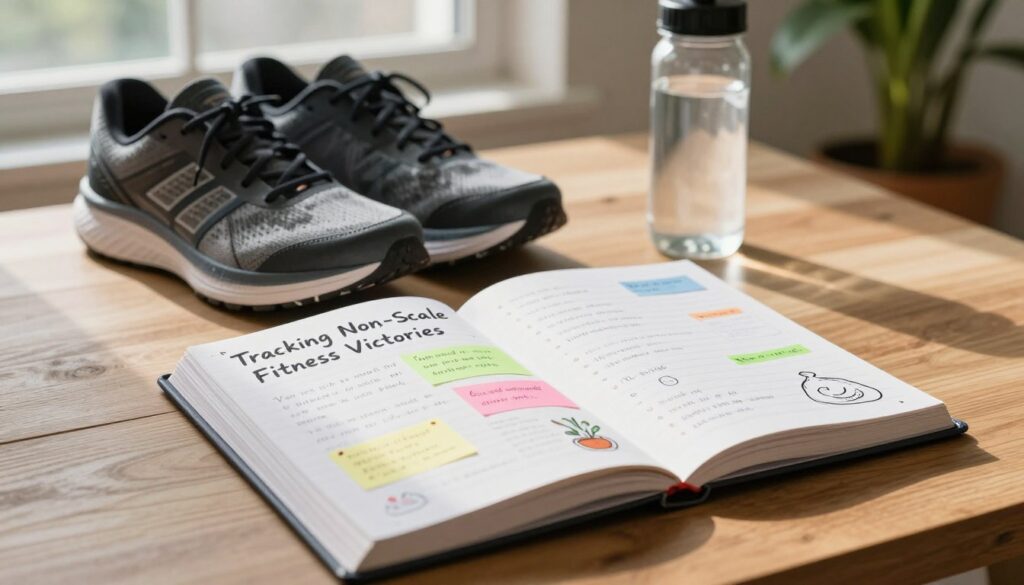
I started a simple notebook for tracking. After each workout, I write three things: what I did, a non-scale victory, and how I felt. Writing “felt energized” or “proud I showed up” boosts my mood. This journal is a key motivator, showing real progress, not just calories burned.
Using Past Wins to Fuel Present Efforts
On low-energy days, I don’t force motivation. I look at my journal. Reading about past successes reminds me of my abilities. It’s like having a personal cheerleader.
By focusing on what truly matters, you create a story of success. This is the path to lasting motivation.
Spark Joy in Movement: Keeping Your Routine Alive and Exciting
I learned that keeping up with exercise isn’t about forcing it. It’s about finding the fun again. When workouts get dull, motivation can disappear. The answer isn’t to work harder. It’s to reignite the spark that makes you want to move.
This section is about making fitness a highlight of your day. It’s about turning it from a chore to something you look forward to.

Seasonal Workout Refreshes to Anticipate Change
Nature changes with the seasons, and so should your workouts. This keeps things interesting and prevents boredom. I love these changes because they make my routine feel fresh and connected.
Here’s how I break it down:
- Spring & Summer: I do outdoor workouts like strength exercises in the park and trail runs. Longer days make me want to move more.
- Fall: I enjoy long hikes in the crisp air and try new indoor classes. It’s a time for change.
- Winter: I focus on indoor activities like dance cardio and hot yoga. It’s about staying warm and energized.
This approach keeps me from getting stuck. I’m always looking forward to the next change.
Say Yes to One New Activity This Month
Staying in your comfort zone can make you feel stuck. I always try one new form of movement every month. It’s about having fun and being curious like a kid.
Last month, I tried rock-climbing. The month before, it was foam-rolling. This month, I might try kickboxing on YouTube. The goal is to try new things and find what you love.
This practice keeps your mind active and reminds you that fitness is fun. It’s not a chore.
Crafting the Ultimate Motivational Playlist or Podcast Queue
A great soundtrack can make any workout better. I don’t just play random music. I curate my listening experience with care. It’s a three-part system.
For High-Energy Workouts: I have playlists for different moods. Upbeat music gets me moving without thinking.
For Steady-State or Mindful Movement: Podcasts and audiobooks are perfect for these times. They make my workouts feel shorter.
For the Ultimate Warm-Up: I have a special playlist of three songs. They always get me ready to go.
Updating your playlist takes just twenty minutes. It’s a small effort with big rewards. It adds joy to any workout.
Grace Over Guilt: The Art of Compassionate Consistency
Guilt is a terrible workout partner—it weighs you down and makes every step feel heavier. For years, I treated every missed session as a personal failure, a crack in my willpower. This mindset created a cycle of intense effort followed by burnout and shame. True, lasting fitness isn’t built on a foundation of self-punishment. It’s built on compassionate consistency, the gentle art of returning to your plan with kindness, not criticism.
This shift changed everything for me. It transformed exercise from a rigid chore into a sustainable practice of self-care. Let’s explore how to trade guilt for grace and build resilience that actually lasts.
Why Planned Rest Days Are a Sign of Strength
Our culture often glorifies the “no days off” mentality. I used to believe that, too. I’d push through fatigue, thinking skipping a rest day proved my dedication. I was wrong. Planned rest is not laziness; it’s a strategic part of getting stronger.
Your muscles repair and grow when you’re not working out. Your nervous system recovers. Your motivation reservoir refills. Scheduling a rest day is a sign of intelligence and long-term commitment. It shows you understand how the body actually improves.
I now mark my rest days on my calendar with as much importance as my workout days. I see them as active investments in my next great session. This mindset shift turns rest from a guilty secret into a celebrated part of the process.
My No-Shame Protocol for Getting Back on Track
Life happens. A busy week, an illness, or just a wave of low energy can disrupt the best-laid plans. The old me would have spiralled: “I’ve ruined everything. I need to do two workouts tomorrow to make up for it.” That punitive approach only led to more skipping.
Now, I follow a simple, no-shame protocol:
- Acknowledge, Don’t Catastrophize: Simply note, “I missed my workout yesterday,” without adding a story of failure.
- Return to the Next Scheduled Thing: I look at my calendar and do the very next workout I have planned. No “make-up” sessions. This prevents overwhelm.
- Start Extra Gentle: If it was a cardio day, I might walk instead of run. The goal is just to reignite the habit, not punish my body.
- Celebrate the Return: Afterward, I acknowledge the win: “I got back to it. That’s what matters.”
This protocol breaks the guilt cycle. It makes the comeback feel easy and achievable, which is the key to never quitting for good.
Quieting the Voice That Says You’ve Failed
That inner critic can be loud after a lapse. It whispers, “You’re inconsistent,” or “You’ll never stick with it.” I’ve learned to talk back with facts and kindness.
First, I get factual. I might look at my fitness journal and count the workouts I did complete this month. The evidence usually shows I’m doing far better than the critic claims.
Second, I use a mantra of self-compassion. Something like: “My worth is not defined by my workout log. I am a person who cares for my health, and sometimes that means rest.”
Progress is never a straight line. It’s a series of comebacks.
Finally, I ask myself a kinder question. Instead of “Why am I so lazy?” I ask, “What do I need right now to feel good and energized?” Often, the answer is a walk, some stretching, or even just a quiet evening. This approach starves the critic of its power and builds a more supportive inner coach.
Embracing grace over guilt transforms your entire fitness journey. It turns setbacks into mere pauses and makes your routine something you can truly sustain for life.
From Effort to Automatic: Cementing Your Fitness Habit
Turning exercise into a part of who you are is key to lasting fitness. This change brings true freedom. You no longer fight with yourself every day.
Instead, you believe I am someone who works out. It’s not about being perfect. It’s about creating a system that works without you thinking.

The Life-Changing Magic of Showing Up Consistently
It’s not about how hard or long your workouts are. The magic is in showing up. Consistency changes your brain.
Every time you follow through, you prove to yourself you keep your promises. Over time, this builds a new self-image.
The decision-making effort fades away. You start asking “When will I work out today?” instead of “Will I?” This is the start of a true habit.
Habit Stacking: Piggybacking Exercise on Daily Routines
You don’t need to find new time for exercise. You can add it to your daily routines. This smart method is called habit stacking.
Choose a daily action as your anchor. Then, link your new workout to it. The existing habit cues the new one.
Your brain loves this pattern. It makes the new action feel automatic, following a trusted routine.
Example: Post-Coffee Stretch, Pre-Dinner Walk
Here are two ways I use habit stacking:
- Post-Coffee Stretch: My morning coffee is a must. After finishing, I do a 5-minute stretch. The coffee cues the stretch, a new healthy habit.
- Pre-Dinner Walk: Dinner is every night. I walk for 15 minutes before cooking. It aids digestion, clears my head, and adds movement effortlessly.
Creating a Pre-Workout Ritual You Genuinely Love
Your ritual signals to your brain and body. It means “Something good is coming.” It’s not about complicated prep.
It’s about a short, fun sequence you look forward to. It could be a favorite pump-up song, a special drink, or three power poses.
My ritual is simple. I wear my workout clothes and listen to a high-energy song. By the time it ends, I’m ready to go. This small joy makes starting workouts inevitable.
To see how your mindset needs to change for habits to stick, look at this comparison:
| Aspect | The Old Mindset | The Habit-Based Mindset |
|---|---|---|
| Focus | Relying on daily motivation and willpower. | Relying on built systems and environmental cues. |
| Self-View | “I’m trying to work out.” It’s a temporary task. | “I am someone who works out.” It’s part of my identity. |
| Success Metric | How hard I pushed myself in a single session. | How consistently I showed up over time. |
The journey from effort to automatic is beautiful. It starts with a single action, gets a boost from smart stacking, and is welcomed by a little ritual. Soon, you’re not just doing workouts. You’re living a life that values movement.
Conclusion
The journey to feeling motivated starts where you are today. It’s a personal path.
Remember, motivation comes after you take the first step. Taking action builds momentum. Self-compassion, not guilt, fuels you.
Your progress is built on small, consistent steps. Prepare your gear the night before. Make a promise to yourself to do just five minutes.
Celebrate every small victory, not just the scale. You now have tools to stay motivated, even on tough days.
Try one idea from this article today. Put on your shoes for a short walk. Schedule ten minutes of stretching. Your effort, not perfection, leads to lasting change.
You have the strength to make this happen. Your energy and vitality are worth the effort. Start your journey now.